How to Choose the Right Chain Length for a Handmade Pendant
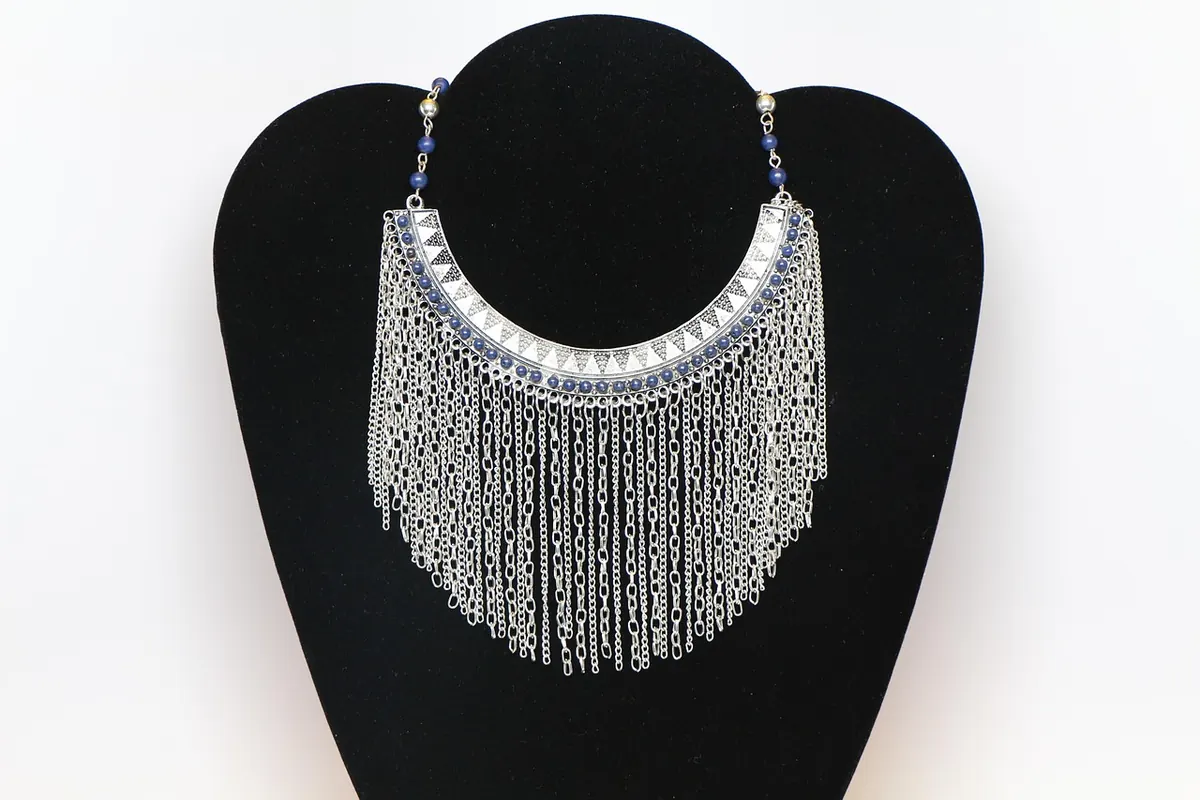
Most unworn pendants are not unloved. They sit in a drawer because the chain puts them in the wrong place: too high under a collar, too low in a V-neck, or resting on the bust where the piece tips forward and shows its back. Chain length is not an afterthought to a pendant. It decides where the pendant lives on the body, and it takes about ten minutes and a piece of string to get right.
Start with the pendant, not the chain
Length and pendant size are really one decision. A small disc, a slim bar or a single bezel-set stone can carry a short chain because there is not much to look at. Put that same chain on a 40mm medallion and the whole thing crowds the throat.
The measurement that matters most is the pendant's drop: the distance from the top of the bail, the loop the chain passes through, to the lowest point of the piece. That drop is added to the chain. A 45cm chain carrying a 4cm pendant puts the bottom of the pendant roughly 49cm down the chest, which is a very different look from the same chain with a 12mm charm.
Weight matters too. A heavy pendant pulls the chain forward and down, so it sits lower than the tape measure suggests, and it can slide to one side as the wearer moves. If your piece is on the heavy side, choose a chain slightly shorter than your measurement and pick a heavier gauge so the pendant stays where you put it.
What the standard lengths actually do
Chain is still sold in inches in most UK shops, with centimetres alongside. As a rough guide, here is where each length tends to land on an adult wearer:
- 35 cm (14 in) - a choker, sitting at the base of the throat. Best for very small, light pendants, and often worn with an extender so it can be slackened.
- 40 cm (16 in) - the hollow at the base of the neck, just above the collarbone. A classic spot for one small pendant.
- 45 cm (18 in) - the most common length. It falls just below the collarbone and above most necklines, which is why it suits so many people.
- 50 cm (20 in) - upper chest, a little below the collarbone. Good for medium pendants and for wearing over a fine knit.
- 55 cm (22 in) - mid-chest. This is where larger pendants start to look comfortable rather than cramped.
- 60 cm (24 in) - lower chest, often at or just above the bust. Excellent over high necklines and turtlenecks.
- 75 cm (30 in) and longer - a long line, worn single, doubled, or layered with shorter chains.
Treat these as starting points rather than rules. The same 45cm chain hangs differently on two people of the same height, and the rest of this article is about why.
The neckline decides as much as the pendant
Put a pendant on a crew neck and the chain lies on fabric, not skin. A length that looks perfect on a bare collarbone can suddenly sit awkwardly somewhere between the shirt edge and the throat. The fix is to commit: either go short enough that the pendant sits clearly above the collar, or long enough that it drops below the neckline entirely.
A few pairings that tend to work:
- V-neck: the point of the V is a natural target. A pendant sitting a centimetre or two above the point looks deliberate, and so does one that falls well below it. The one place to avoid is exactly on the edge, where it reads as though the pendant has slipped.
- Scoop and square necks: same logic. Land the pendant in the open space, or clear the fabric altogether.
- Boat necks and wide collars: the neckline is already a strong horizontal line across the collarbone, so a short chain can feel busy. Something around 55 to 60cm usually sits better.
- Turtlenecks and roll necks: the collar adds thickness, so the chain needs extra length to clear it. Anything shorter than about 50cm tends to sit on the roll itself.
- Buttoned shirts: leave one more button open than usual and let the pendant sit in the opening or just below it. A chain that vanishes under the placket looks accidental.
A simple rule: leave at least two centimetres between the lowest point of the pendant and the edge of the neckline. If it is closer than that, change the chain rather than the pendant.
Height, torso and build
Total height is a rough guide at best. Torso length is what moves the landing point, and two people of the same height can have torsos that differ by several centimetres. The chain follows the torso, not the height chart.
Neck and shoulder width matter as well. A chain has to travel around the neck before it hangs, so a wider neck leaves less chain for the front and the pendant sits higher. A long neck and narrow shoulders can make a 50cm chain drop lower than expected.
If the chain rests on the bust, the pendant will tilt and turn as the wearer moves. The answer is the same as with necklines: short enough to sit above the curve, or long enough to hang clear below it. Mid-bust is the one place a pendant rarely stays flat.
Posture counts too. Someone who stands with their shoulders back will find a chain sits higher and closer than someone who slouches. That is not a reason to correct anything, just a reason to measure on the person, standing as they normally stand.
A five-minute measuring method
- Find a chain the wearer already likes the fit of. Lay it flat and measure from one end to the other, including the clasp but not any extender. That number is your target.
- No suitable chain to hand? Use a piece of string or ribbon about 90cm long. Hold the midpoint at the nape of the neck and bring both ends forward over the chest.
- Let the ends hang, then slide them until the point where they would meet sits exactly where the pendant should land. Pinch the two ends together there.
- Lift the string off without losing the pinch, lay it flat, and measure end to end. That is your target length in centimetres
Photo: arnima / Pixabay